
10 min read · Neuroscience · biology · quantum phyiscs
Connections of the Neuron
Microtubules, quantum physics, and the search for consciousness
Inside the Neuron
When we think about how the brain works, we often picture neurons sending electrical signals, passing chemical messages across synapses, and forming networks through which information travels. Much of neuroscience investigates these exchanges between cells. But each neuron also contains an organized system of molecular structures that helps make those exchanges possible.
Among them are microtubules, which have also become the focus of an unusual proposal about consciousness. Physicist Roger Penrose and anesthesiologist Stuart Hameroff suggest that they could support quantum processes that contribute to conscious experience (Hameroff & Penrose, 2014).
Their theory invites us to look at a familiar biological system from a different scale, beginning with the physical organization inside a neuron.
A Structure Built to Change
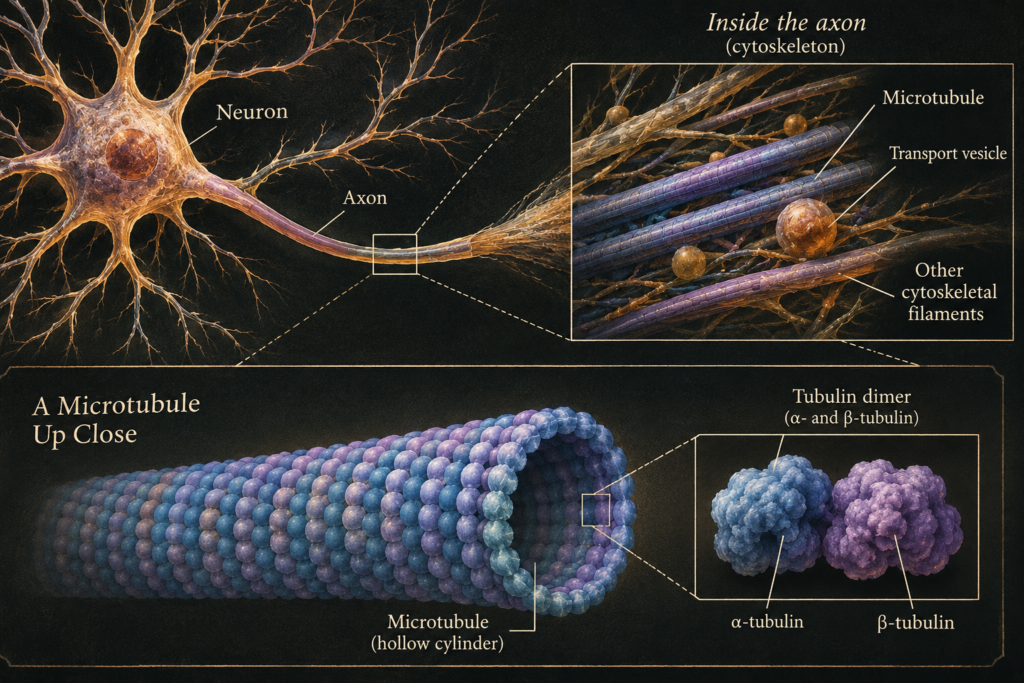
Inside every neuron is a network of tiny structures that helps the cell maintain its shape, organize its contents, and transport materials from one region to another. Part of this network is made of microtubules which are tiny, hollow structures that help neurons maintain their shape, transport materials, and organize their internal components. (Kapitein & Hoogenraad, 2015).
Microtubles belong to the cell’s internal framework, known as the cytoskeleton. But unlike the rigid framework of a building, this structure can change. Microtubules can grow, shrink, and reorganize as a cell develops or responds to its needs. This behavior, known as dynamic instability, is one of their well-established physical properties (Desai & Mitchison, 1997).
In neurons, microtubules are particularly important because these cells often extend far beyond their central body. Proteins called molecular motors move along microtubules, carrying materials such as mitochondria and components needed for communication between neurons. Microtubules also help guide the growth of axons and dendrites, the extensions through which neurons send and receive signals (Kapitein & Hoogenraad, 2015).
Microtubules are organized differently in axons and dendrites, helping determine where materials can travel and how the neuron develops and maintains its specialized shape. Microtubules help build, maintain, and organize the cells that make brain activity possible. Changes in this organization can therefore affect the cell’s ability to function (Kapitein & Hoogenraad, 2015).
The ordered arrangement of tubulin proteins raises another question: could their interactions support processes beyond the structural and transport functions we already understand?
Why Look Inside the Neuron?
What does it take for physical activity in the brain to become a conscious experience?
Neuroscientists can identify patterns of brain activity associated with different states of consciousness. During wakefulness, sleep, and anesthesia, changes occur in how neurons communicate and how activity is coordinated across brain regions. Researchers study these relationships to understand which processes are necessary for conscious awareness and how information becomes available across the brain. (Koch et al., 2016).
These findings have helped explain many conditions under which consciousness changes. But identifying the neural activity associated with an experience is not necessarily the same as explaining why that activity is accompanied by subjective experience—what it feels like to see a color, hear a sound, or have a thought.
Mathematical physicist Roger Penrose approached this question from a different direction. He argued that some aspects of human mathematical understanding could not be fully explained by conventional algorithms—sets of rules that a computer could follow. This is what led him to consider whether consciousness might involve physical processes beyond those captured by conventional computational models (Penrose, 1989; 1994).
Anesthesiologist Stuart Hameroff had been investigating whether microtubules participate in information processing inside cells. He was particularly interested in the repeating arrangement of tubulin proteins and the possibility that interactions among them could support coordinated activity beyond their established biological functions (Hameroff & Penrose, 2014).
Their collaboration brought these ideas together in a theory called Orchestrated Objective Reduction, or Orch OR. This theory proposes that coordinated quantum states could develop within microtubules and influence neuronal activity.
In their 2014 review, Hameroff and Penrose proposed that quantum states associated with tubulin proteins could develop collectively within neuronal microtubules. Biological activity would help organize these states, while a proposed that quantum superpositions might undergo a process called objective reduction. This would determine when they resolve into definite outcomes rather than requiring a conscious observer to produce a definite outcome. In his hypothesis, the time before reduction depends on the gravitational self-energy associated with differences between the possible states (Penrose, 1996).
Orch OR combines this proposed reduction process with the biological organization of microtubules. Hameroff and Penrose suggest that the timing and coordination of these events could contribute to moments of conscious experience.
From Molecular Structure to Quantum Possibility
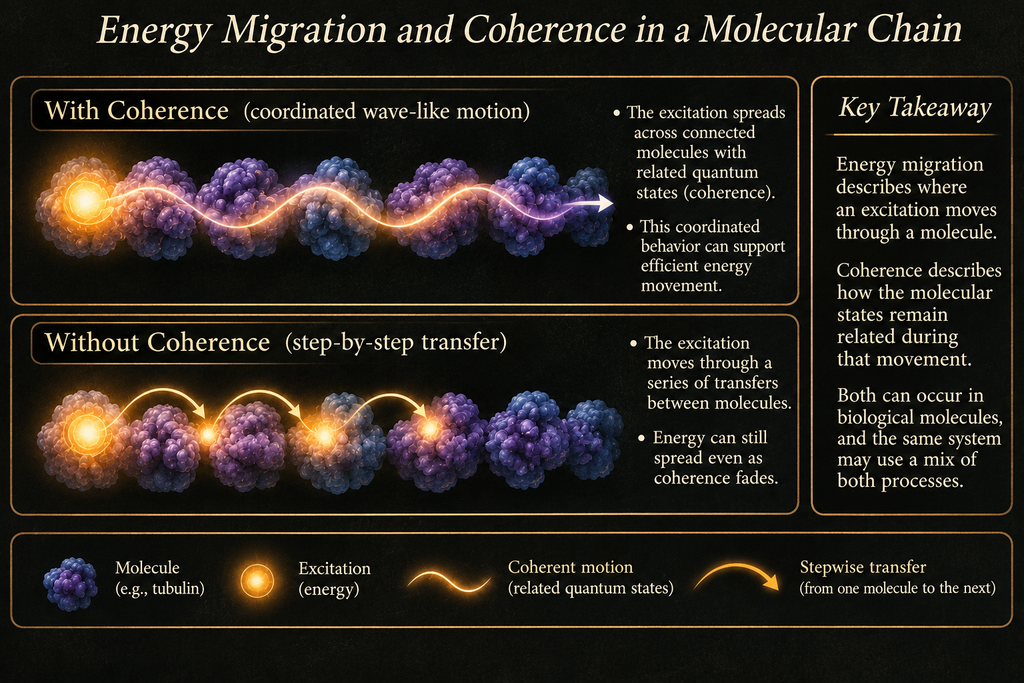
In quantum physics, a system can exist in a superposition, a state described by more than one possible outcome. When different parts of a quantum system maintain a defined relationship with one another, that relationship is called coherence. Those systems interact with their surroundings and if the relationships are disturbed, it is called decoherence.
In order to participate in the coordinated activity Orch OR describes, the proposed quantum states would need to retain coherence long enough to coordinate conscious activity.
In 2000, physicist Max Tegmark published an objection to this theory. He calculated that proposed quantum states in the brain would lose coherence too quickly to play the role suggested by quantum theories of consciousness (Tegmark, 2000).
Just a few years later, his calculations were challenged. It was argued that Tegmark’s model did not adequately represent the particular quantum states proposed for microtubules. By using different assumptions about those states and their interactions with the surrounding environment, they obtained estimates that allowed coherence to persist longer (Hagan et al., 2002).
The disagreement is important because neither study directly measured the proposed quantum states inside living neurons. It highlights an often overlooked fact that a calculation can only tell us what follows from the physical conditions it assumes.
In order to verify this proposal, researchers would need to establish that the relevant quantum states exist in neuronal microtubules, persist for the required intervals, and influence neural activity in the ways Orch OR predicts.
What Has Actually Been Observed?
One way researchers have begun investigating microtubules beyond their established structural roles is by studying their interactions with anesthetic compounds. Anesthesia is relevant because it can reversibly disrupt conscious responsiveness. However, anesthetics also affect established parts of neuronal signaling, including receptors and ion channels. Finding an effect on microtubules would therefore identify another possible part of the process, not necessarily the origin of consciousness.
Two recent studies approach this relationship at different scales. One examines how anesthetic compounds affect energy movement through microtubules in a laboratory setting. The other investigates whether changing microtubule stability alters an animal’s response to anesthesia.
Anesthesia can suppress the brain activity needed for conscious responsiveness. Researchers use anesthetics to investigate the biological processes involved in transitions between responsive and unresponsive states.
In 2023, Kalra and colleagues studied tubulin proteins and assembled microtubules in vitro, outside a living brain. They excited naturally occurring light-sensitive parts of the proteins, then analyzed fluorescence measurements to estimate how far the resulting excitation energy could travel (Kalra et al., 2023).
When tubulin proteins were assembled into microtubules, the estimated distance increased from about 4 to 6.6 nanometers. The significance is not the distance itself, but the difference: arranging the same proteins into an ordered structure appeared to allow excitation energy to spread farther than it did among unassembled proteins.
Two anesthetics were introduced, etomidate and isoflurane. The estimated distances decreased to 5.6 and 5.8 nanometers, respectively. This suggests that the anesthetics altered molecular interactions involved in energy transfer through the microtubule structure (Kalra et al., 2023).
The researchers found that conventional Förster-transfer calculations did not fully account for the energy migration they estimated in microtubules.
That raises an interesting question: might the ordered arrangement of tubulin proteins allow additional interactions or collective effects that the simpler model doesn’t capture?
Kalra’s experiment examined what happens to energy transport inside microtubules when anesthetics are introduced. A related question can be approached from the other direction: if microtubules are altered before anesthesia, does the animal respond differently to the anesthetic? This is the question Khan and colleagues investigated using a drug that stabilizes microtubules.
A 2024 study approached the question in living animals. Eight male rats were treated with epothilone B, a drug that stabilizes microtubules, and their responses to the anesthetic isoflurane was examined (Khan et al., 2024).
They measured how long it took each rat to lose its righting reflex: the ability to turn upright when placed on its back. Loss of this reflex is commonly used as a behavioral indicator of anesthetic induced unconsciousness.
After epothilone B treatment, the rats took an average of 69 seconds longer to lose the reflex than during their earlier control sessions. Seven of the eight rats showed an increase in their average response time, and the overall difference was statistically significant (Khan et al., 2024).
Why is this relevant to consciousness? If changing microtubule stability results in a change in an animal’s response to anesthesia, microtubules may be involved in processes that relate to the ability to their ability to stay conscious. But their established roles in cellular transport and organization offer other possible explanations. The study was also small, and the control sessions occurred before treatment, leaving limitations in how confidently the effect can be attributed to a particular mechanism.
Both of these studies provide two measurable points of investigation: anesthetics can alter excitation energy migration through isolated microtubules, and changing microtubule stability can affect an animal’s behavioral response to anesthesia. They approach the relationship between microtubules and anesthesia from different directions.
The next challenge to address in future research is to determine which molecular processes produce these effects, whether they influence neuronal activity, and whether any involve the coordinated quantum states proposed by Orch OR.
Returning to the Neuron
We began with neurons exchanging electrical and chemical signals, a picture that tells us how information moves through the brain. Looking inside those neurons adds another scale to the investigation. The signals a neuron sends depend partly on processes occurring within the cell: materials must be transported, proteins maintained, and cellular structures organized as conditions change.
Microtubules are one part of that organization. Their established roles in cellular structure and transport already make them important to understanding neurons. Research into their electronic properties and responses to anesthetic compounds opens further questions about how their molecular behavior interacts with the activity of the cell.
Penrose and Hameroff propose a more specific possibility: that quantum processes within these structures participate in the physical events underlying conscious experience. Investigating that proposal requires connecting several levels of observation, from the behavior of tubulin molecules, through changes in microtubules and neuronal activity, to the larger patterns of brain function associated with conscious states.
The investigation returns us to a familiar neuron, but with a broader question about what its activity includes. How much of what a neuron does can be understood from the signals it sends, how much depends on the processes unfolding within it and how much of it’s behavior is determined by it’s coordination with the systems around it?
Show the source trail Follow the evidence Established biology → proposed mechanism → experimental tests
The research behind this article moves between different kinds of evidence. Cell biology explains how microtubules are built and behave. The Orch OR papers propose a particular quantum mechanism for consciousness. Experiments measure physical properties of microtubules and changes in animals’ responses to anesthesia.
These sources help us follow what is established, what is proposed, and which connections have not yet been demonstrated.
Established biology & proposed mechanism
The cellular foundation of the article and the theoretical work defining Orch OR and its feasibility requirements.
Established biology · Scientific review Desai & Mitchison, 1997 How microtubules grow, shrink, and reorganize
What it supports
The review explains microtubule assembly from tubulin subunits, the role of GTP hydrolysis, and dynamic instability: transitions between growth and shrinkage, including catastrophe and rescue. These are established features of microtubule biology.
What it doesn’t establish
The review does not investigate quantum coherence, objective reduction, or consciousness. The ability of microtubules to change their organization is not itself evidence that they perform quantum computation.
Why it matters here
It grounds Section 2 in the physical behavior of the structure before the article turns to proposed functions beyond its established cellular roles.
Desai A, Mitchison TJ. (1997). Microtubule Polymerization Dynamics. View source ↗
Theoretical analysis · Decoherence Hagan, Hameroff & Tuszyński, 2002 Could the proposed quantum states persist long enough?
What it supports
The authors revisit calculations of how quickly proposed microtubule quantum states would lose coherence through environmental interactions. They argue that different assumptions about the states and their surroundings can produce longer estimated coherence times than earlier critiques suggested.
What it doesn’t establish
The paper is a theoretical calculation, not a measurement of coherence in living neurons. Hameroff is a coauthor, so it should be read as a contribution to the feasibility debate rather than independent experimental confirmation.
Why it matters here
It shows why a decoherence estimate depends on the exact physical state being modeled. Before asking how long coherence lasts, researchers need to specify what is supposed to remain coherent.
Hagan S, Hameroff SR, Tuszyński JA. (2002). Quantum Computation in Brain Microtubules: Decoherence and Biological Feasibility. View source ↗
Experimental investigations
Measurements involving microtubule energy transport and anesthetic responses, at different scales and under different experimental conditions.
Foundational theory · Review Hameroff & Penrose, 2014 The proposed Orch OR sequence
What it supports
This review sets out the Orch OR proposal: quantum states associated with tubulin in neuronal microtubules would be biologically organized and undergo Penrose’s proposed objective reduction. The authors link these events to conscious experience.
What it doesn’t establish
Presenting a physical model does not demonstrate that its proposed tubulin states exist in living neurons, that gravitational objective reduction occurs, or that these events generate consciousness.
Why it matters here
It gives us the theory’s actual commitments. The article can assess a specific proposed mechanism rather than a vague claim that the brain is somehow quantum.
Hameroff S, Penrose R. (2014). Consciousness in the Universe: A Review of the ‘Orch OR’ Theory. View source ↗
Direct experiment · Animal anesthesia Khan et al., 2024 Stabilizing microtubules delayed loss of a righting response
What it supports
Eight male rats were tested under isoflurane anesthesia before and after treatment with epothilone B, a drug that stabilizes microtubules. After treatment, the rats took an average of 69 seconds longer to lose the ability to turn themselves upright when placed on their backs (the righting reflex); seven of eight showed a delay.
What it doesn’t establish
The study involved only eight animals, and baseline testing preceded treatment rather than using a randomized treatment order. Loss of the righting reflex is a behavioral indicator of anesthetic effect, not a direct measurement of subjective consciousness. The experiment did not isolate a quantum mechanism.
Why it matters here
It asks a different, biologically important question from the energy-migration experiment: if microtubules are made more stable, does an animal’s response to anesthesia change? In this small study, it did.
Khan et al. (2024). Microtubule-Stabilizer Epothilone B Delays Anesthetic-Induced Unconsciousness in Rats. View source ↗
Hypothesis & Interpretation
Assessments of what the proposed mechanism explains and whether the available arguments justify it.
Direct experiment · Molecular photophysics Kalra et al., 2023 Anesthetics reduce estimated excitation-energy migration
What it supports
Fluorescence-based measurements suggested that electronic excitation energy traveled farther in assembled microtubules (about 6.6 nm) than in unassembled tubulin (about 4 nm). With etomidate or isoflurane present, the estimated migration distance in microtubules fell to about 5.6 nm or 5.8 nm, respectively. The measured change concerns distance, not a delay in transmission.
What it doesn’t establish
The experiment did not measure conscious experience or Penrose’s proposed gravitational reduction. Energy migration under the laboratory conditions is not a direct measurement of the sustained, coordinated quantum states Orch OR requires in neurons.
Why it matters here
It identifies a measurable electronic property of microtubules that changes when anesthetic compounds are added. This provides a specific molecular effect to investigate, rather than assuming that anesthetics act only through other cellular targets.
Kalra AP et al. (2023). Electronic Energy Migration in Microtubules. View source ↗
Established biology · Scientific review Kapitein & Hoogenraad, 2015 How microtubules organize the structure and transport of neurons
What it supports
This review describes how microtubules help neurons develop and maintain their distinctive shapes. Their arrangement and orientation provide tracks for transporting materials over long distances, while changes in the microtubule network contribute to neuronal growth, organization, and local signaling.
What it doesn’t establish
The review examines established cellular functions rather than testing whether microtubules generate conscious experience. Their importance to neuronal activity does not identify which intracellular processes, if any, directly participate in consciousness.
Why it matters here
It provides the neuronal context for Section 2. Before considering additional proposals about microtubules, readers can see what these structures already contribute to the cells that communicate throughout the brain.
Kapitein LC, Hoogenraad CC. (2015). Building the Neuronal Microtubule Cytoskeleton. View source ↗
Established neuroscience · Scientific review Koch et al., 2016 What researchers can identify about the neural basis of experience
What it supports
The authors review research on the neural correlates of consciousness: patterns of brain activity associated with particular conscious experiences. They distinguish activity related to experiencing something from other processes, such as paying attention, remembering, or reporting what was experienced.
What it doesn’t establish
Identifying neural correlates does not, on its own, resolve why particular physical processes are accompanied by subjective experience. This review is concerned with neural mechanisms and experimental approaches, not with testing Orch OR.
Why it matters here
It establishes what conventional neuroscience is investigating when Section 3 asks how brain activity relates to conscious experience. Penrose and Hameroff’s proposal can then be understood in relation to an active field of research, rather than as a replacement for an empty explanation.
Koch C, Massimini M, Boly M, Tononi G. (2016). Neural Correlates of Consciousness: Progress and Problems. View source ↗
Foundational argument · Books Penrose, 1989 & 1994 Why Penrose questioned whether thought could be explained by algorithms alone
What it supports
In The Emperor’s New Mind and Shadows of the Mind, Penrose argues that certain aspects of mathematical understanding cannot be fully accounted for by rule-following computation. Drawing on mathematical logic, he develops the case for investigating physical processes beyond conventional computational explanations of mind.
What it doesn’t establish
Penrose’s argument about the limits of computation is contested. These books present the reasoning that motivated his search for a new physical account; they do not provide an experiment showing that human understanding is noncomputable or that microtubules carry out the proposed processes.
Why it matters here
These books explain the starting point of Penrose’s contribution to Orch OR. His interest in consciousness did not begin with microtubule anatomy; it began with a question about whether computation alone could account for mathematical understanding.
Penrose R. (1989). The Emperor’s New Mind: Concerning Computers, Minds, and the Laws of Physics. View book ↗
Penrose R. (1994). Shadows of the Mind: A Search for the Missing Science of Consciousness. View book record ↗
Theoretical physics · Objective reduction Penrose, 1996 A proposed gravitational limit on quantum superpositions
What it supports
Penrose examines a quantum superposition involving different distributions of mass and considers how each would affect spacetime. He proposes that the gravitational difference between the alternatives could be associated with an intrinsic timescale for a superposition to reduce to a definite state.
What it doesn’t establish
The paper develops a proposed physical account of quantum-state reduction. It does not report an experimental observation of gravitationally induced reduction, and it does not test whether such events occur in neuronal microtubules or correspond to conscious experiences.
Why it matters here
It identifies the objective-reduction component of Orch OR. The proposal concerns not only how quantum states might be coordinated inside microtubules, but also what physical process would bring those states to a definite outcome.
Penrose R. (1996). On Gravity’s Role in Quantum State Reduction. View source ↗
Critical analysis · Theory Reimers et al., 2014 A challenge to the scientific justification for Orch OR
What it supports
This critical commentary disputes the scientific justification for the revised Orch OR proposal. It offers a counterpoint to the assumptions and physical arguments used by the theory’s proponents.
What it doesn’t establish
A critical theoretical analysis does not by itself settle every empirical question about microtubule physics or demonstrate that no biologically relevant quantum effects can occur.
Why it matters here
It helps readers distinguish an internally developed feasibility argument from broader scientific agreement. The disputed assumptions deserve examination alongside the proposal itself.
Reimers JR et al. (2014). The Revised Penrose–Hameroff Orchestrated Objective-Reduction Proposal for Human Consciousness Is Not Scientifically Justified. View source ↗
Theoretical analysis · Decoherence Tegmark, 2000 How quickly would proposed quantum states lose coherence?
What it supports
Tegmark calculates how rapidly certain proposed quantum states associated with brain activity would lose coherence through interactions with their surroundings. For the states and conditions he modeled, the estimated decoherence times were far shorter than the timescales of ordinary neuronal signaling, posing a physical challenge to quantum accounts of brain computation.
What it doesn’t establish
The estimates follow from the states and environmental interactions specified in the calculation; they are not direct measurements inside neurons. Other proposed states or physical assumptions require their own analysis, which is part of the disagreement addressed by Hagan, Hameroff, and Tuszyński.
Why it matters here
It makes the coherence requirement in Section 4 concrete: a proposed quantum mechanism needs enough time to operate before environmental interactions disrupt it. Reading Tegmark alongside the 2002 response reveals which assumptions are under debate.
Tegmark M. (2000). Importance of Quantum Decoherence in Brain Processes. View source ↗
Supportive interpretation · Review Wiest, 2025 An argument for a quantum microtubule account of consciousness
What it supports
Wiest reviews and interprets findings that the author considers consistent with a quantum microtubule account of consciousness, including arguments about how such a framework might address longstanding questions about conscious experience.
What it doesn’t establish
This is an interpretive review rather than a new experiment directly detecting Orch OR states or gravitational objective reduction. The strength of its conclusions depends on the evidence and assumptions it brings together.
Why it matters here
It shows how a supporter of the broader microtubule-consciousness hypothesis interprets recent findings. Read alongside the critical analysis, it makes the disagreement over what the evidence warrants more visible.
Wiest MC. (2025). A Quantum Microtubule Substrate of Consciousness Is Experimentally Supported and Solves the Binding and Epiphenomenalism Problems. View source ↗
Where the trail ends
Microtubules are established components of neurons, and their assembly and transport functions are well studied. Laboratory measurements show electronic excitation-energy migration through assembled microtubules, including changes in the presence of anesthetic molecules. A small animal study also found that stabilizing microtubules altered the timing of a behavioral response to anesthesia.
Orch OR proposes a more specific chain of events: coordinated quantum states in tubulin, persistence of coherence in living neurons, gravitational objective reduction, and a role for those events in conscious experience. The studies in this trail investigate parts of the surrounding biology and physics, but do not yet measure that full chain.
The next question is therefore experimental: which proposed quantum states can be identified in neurons, how long do they persist, and what distinctive predictions would connect them to neuronal activity and consciousness?
Leave a Reply