
THE LOOKING GLASS · 10 MIN READ
Same Body, Different State
A planarian can rebuild a body that looks normal, yet carry a different regenerative future. If the visible body has returned, what remained changed?
Observation
A planarian flatworm is cut in half. Instead of dying, each piece can rebuild what is missing.
Nothing especially strange there—at least not for a planarian.
But in a 2017 experiment from Michael Levin’s group at Tufts, researchers briefly altered the bioelectric signaling of regenerating worms. Some regenerated with two heads. Others rebuilt normal-looking bodies.
Then the apparently normal worms were cut again.
This time, without repeating the original treatment, some regenerated with two heads.
The first intervention was gone. Their anatomy looked normal. The tissue structure and several biological markers the researchers checked also looked normal. Yet something about the system had remained changed. The difference stayed hidden until the animal had to build itself again. (Durant et al., 2017)
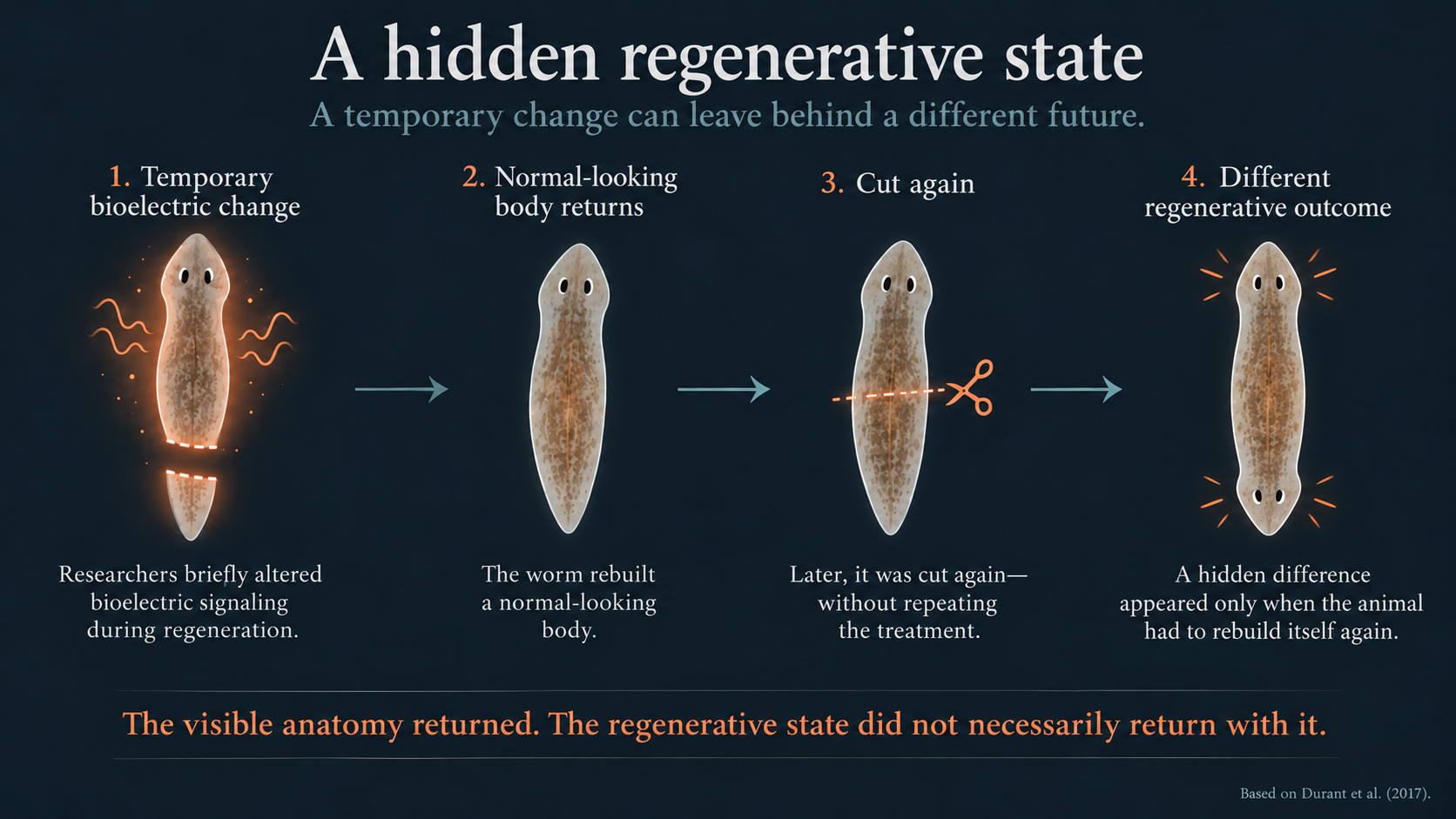
What this diagram is showing: In the Durant et al. experiment, a temporary change to bioelectric signaling could leave behind a regenerative difference that was not obvious from the animal’s visible anatomy. A worm could rebuild a normal-looking body, yet respond differently when cut again later.
The key idea is not that the body stored a picture of the future. The experiment suggests that some part of the system remained in a different state even after the anatomy appeared normal. That hidden difference only became visible when regeneration was triggered again.
Simplified teaching diagram based on Durant et al. (2017); the sequence is conceptual and not shown to anatomical or temporal scale.
That opens a surprisingly difficult question:
If two organisms look the same now, but respond differently to the same injury later, are they actually in the same state?
The question it opened
We are used to thinking of biological information as something written in DNA. And for good reason: DNA carries instructions that strongly shape what cells can build and how organisms develop.
But DNA does not act alone.
Nearly every cell in a planarian contains the same genetic information, yet those cells can become very different tissues and take on very different jobs. And when part of the animal is removed, the remaining cells somehow coordinate their activity around a larger problem: what is missing, and what needs to be rebuilt?
The genome does not have to be rewritten each time the animal loses a head or tail.
So something else must help determine how those genetic instructions are used across the body, at the right place and the right time.
That gives us a more precise version of the question:
What has to remain changed inside a biological system for its future response to remain changed, even after its visible form appears to have returned to normal?
The established science
Levin’s lab studies one part of that larger process: bioelectric signaling.
Cells maintain small electrical differences across their membranes using ion channels and pumps. This voltage difference is called the membrane potential. They can also communicate with nearby cells through structures called gap junctions, which are tiny channels that allow ions and other small molecules to pass between neighboring cells.
This means the electrical state of one cell can become part of a larger pattern spread across a tissue. (Levin & Martyniuk, 2018)
Together, these electrical relationships can influence how groups of cells grow, organize, and respond when tissue is damaged.
In neurons, rapid changes in membrane potential help carry signals through the nervous system. But electrical signaling is not limited to neurons.
Cells throughout the body also use changes in membrane voltage to influence growth, movement, gene activity, and communication with nearby cells.
A single cell does not know how to build an entire head. It responds to local signals: what its neighbors are doing, which molecules are present, how much voltage sits across its membrane, and many other conditions around it.
Yet somehow, the collective activity of many cells can produce a coordinated larger structure.
Experiments in planaria have shown that changing bioelectric communication can change that larger outcome. Altering membrane voltage or disrupting communication through gap junctions can affect whether regenerating tissue builds a head or a tail and, under some conditions, can leave the system more likely to produce the altered pattern again later. (Durant et al., 2017)
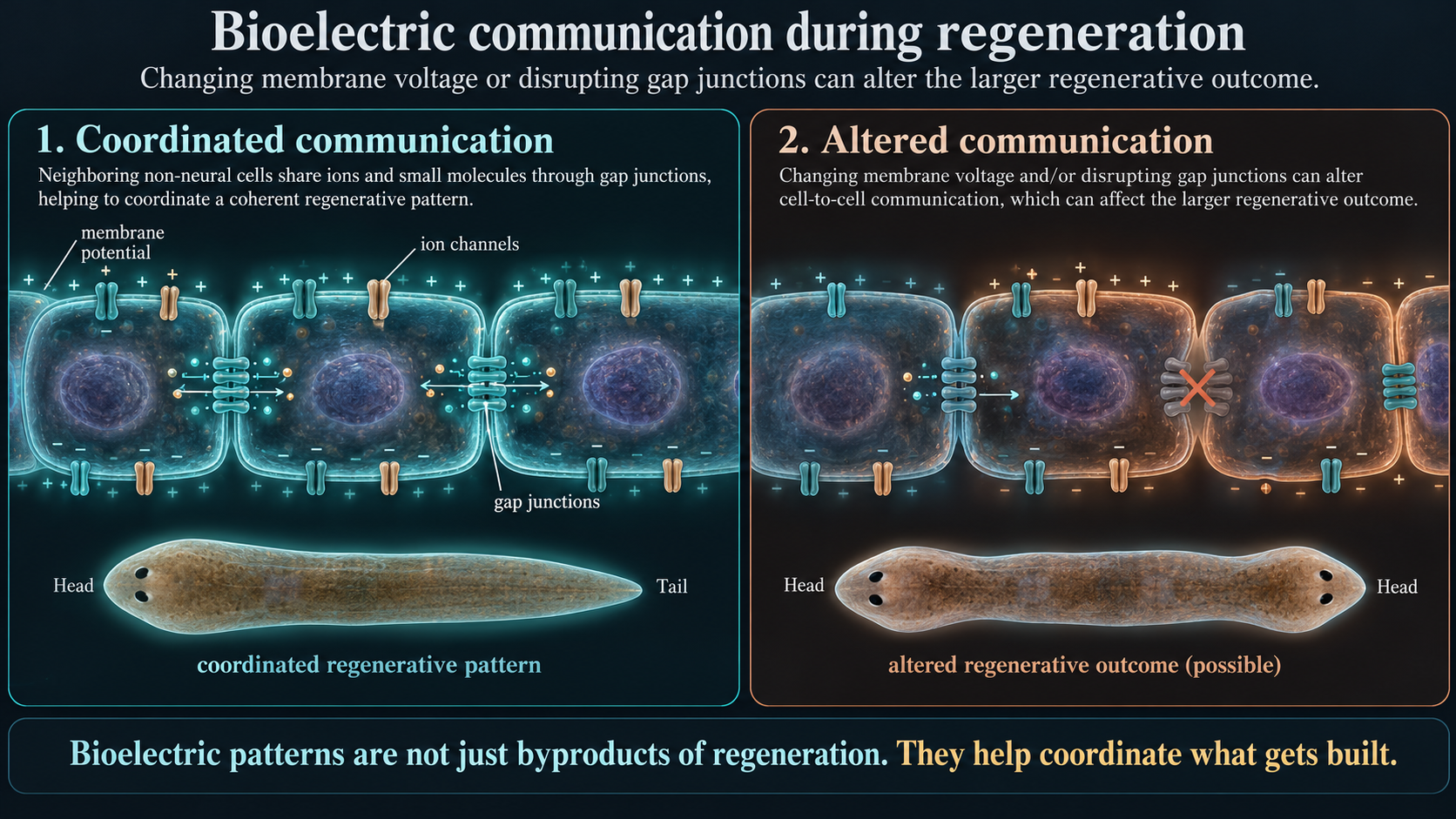
What this diagram is showing: Gap junctions form direct connections between neighboring cells, allowing ions and other small molecules to move from cell to cell. Because ion movement helps establish membrane voltage, changing either ion-channel activity or gap-junction connectivity can change how bioelectric states are coordinated across a tissue. In planaria, experimentally altering these systems can change large-scale regenerative outcomes, including head–tail polarity.
This does not mean gap junctions alone contain a body plan. They are one part of a larger signaling network in which membrane voltage, ion channels, chemical signals, gene activity, and cell-to-cell connectivity continually affect one another.
Simplified teaching diagram; cellular structures and charge distributions are not shown to scale.
So the electrical pattern is not simply a side effect of regeneration.
It appears to be one part of the system helping cells coordinate what gets built.
Models of feedback between membrane voltage and ion-channel activity show how cells can settle into stable electrical states that persist after the original disturbance is gone. This is a model of bistability, conditions under which cells can stably maintain more than one resting voltage state. (Law & Levin, 2015)
That gives us a possible way to understand how a temporary intervention could leave behind a lasting change:
the anatomy may return to normal before every part of the underlying patterning system does.
A body can remember without keeping a picture
If a temporary change can affect what the animal builds later, it is reasonable to ask whether the tissue has somehow remembered what happened.
But biological memory does not require a stored picture or a written set of instructions.
A physical system can carry information simply because its present arrangement changes what it is likely to do next.
A light switch is a simple example. Nothing inside it contains a picture of a bright or dark room. But its position changes what happens when electricity reaches the circuit.
Living systems are vastly more complicated, but the same general idea can apply: information can be carried in relationships between parts of a system rather than stored in one obvious place.
In a tissue, those relationships might include which ion channels are active, how strongly neighboring cells are connected, which genes are active, and the electrical states that cells maintain across the larger network.
Some of those relationships can reinforce one another. Once the system settles into a particular pattern, feedback between its parts can help keep it there.
That means a past event can continue to matter even after the event itself is over.
The system does not need to keep a record of the past.
The past can remain present in the way the system has been changed.
This gives us a useful way to think about the planarians.
Perhaps the important question is not where the animal stores an image of the body it should build.
Perhaps it is how the present state of the system makes some future forms more likely than others.
The bridge: when physics starts talking about information
Once we start asking how a physical system can carry information about what happens next, the question stops belonging only to biology.
Physics has long dealt with systems whose present state affects their future behavior. A magnetic bit can hold information in its orientation. A circuit can behave differently depending on its configuration. A network can store information across many connections rather than in one single location.
These systems are not the same as living tissue.
But they share a useful idea:
Information can be carried by the organization of a physical system.
That makes the planarian result especially interesting. The regenerative difference may not need to be hidden in one molecule, one gene, or one cell. It could instead depend on a larger pattern of relationships distributed across the tissue.
Theoretical physicist S. James Gates Jr. encountered an unexpected connection between physics and information while studying supersymmetry, a theoretical framework in particle physics.
Gates and collaborators used graph-like diagrams called Adinkras to represent parts of that mathematics. They found that the possible structures of those diagrams are closely related to a class of error-correcting codes, the same broad kind of mathematics used to detect and protect information when errors occur during transmission. (Doran et al., 2008)
The connection is not presented as biological evidence, it is a cross-domain mathematical parallel.
But it gives us reason to be careful about assuming that “information” is merely a metaphor pasted onto physics.
Sometimes the mathematics used to describe a physical theory contains structures already familiar from information theory.
That sharpens the question:
When a biological system preserves a pattern across time, are we looking only at matter changing state? Or at matter organized in a way that carries information about what the system can become next?
The unresolved edge
Once information becomes more useful in describing physical systems, a harder question follows:
Is information simply a way of describing how matter is arranged, or is it something more fundamental?
Physicist Melvin Vopson has argued for the second possibility. His work proposes that information may have its own physical significance, including what he calls a second law of information dynamics and a possible relationship between information, mass, and energy. (Vopson, 2019; Vopson & Lepadatu, 2022)
While these ideas are not established laws of physics, they remain intriguing theoretical proposals. These ideas are intriguing theoretical proposals rather than established laws of physics.
Levin’s work does not require us to resolve that debate.
The planarian experiments already leave us with a smaller, and experimentally grounded, mystery.
The experiments suggest that something about the animal’s underlying state can remain different even when the visible body appears to have returned to normal.
Gene activity, chemical signaling, mechanical forces, metabolism, cell-to-cell connections, and the history of the tissue are all interacting. Bioelectric signaling has been shown to be a part of that larger organization.
The return
We began with two planarians that could look the same and still carry different regenerative futures.
At first, the mystery seemed to be about where that difference was hidden.
But the deeper question may be whether “hidden” is even the right way to think about it.
The difference may not exist in one place waiting to be found. It may be carried across the relationships that make up the present state of the system, electrical, chemical, genetic, mechanical, and perhaps in emergent properties of the biological network as a whole.
So when we say that a tissue carries information about what it should build next, where exactly does that information begin and end?
Is it located in particular physical variables?
Is it spread across relationships between many of them?
Or does the distinction between “matter” and “information” become harder to draw when the organization of matter is itself what changes what happens next?
For now, those questions remain open.
And perhaps that is where they are most useful.
Show the source trail
Evidence · Models · Connections
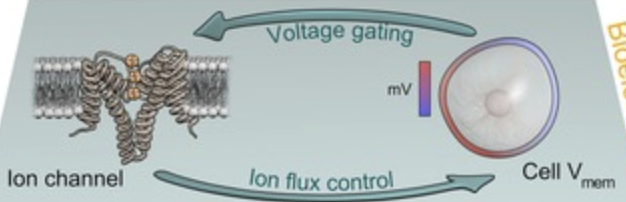
Visual adapted from Pezzulo et al.
(2016), Figure 3, CC BY.
The ideas in this piece do not all carry the same kind of evidence. Some come directly from regeneration experiments; others are models, broader scientific frameworks, mathematical connections, or deliberately speculative questions. Here is where each part comes from.
Durant et al., 2017
Role: Direct experimental evidence
This is the experiment at the center of the article. Researchers temporarily altered bioelectric signaling in regenerating planaria. Some worms regenerated with normal-looking bodies but later produced altered anatomy when cut again, revealing what the authors called a cryptic phenotype. The apparently normal animals did not differ from untreated worms in the tissue structure, polarity-gene expression, or stem-cell distribution the researchers examined; instead, they showed altered patterns of cellular resting potential.
Michael Levin, 2014
Role: Scientific framework / review
Levin reviews evidence that bioelectric signaling forms a layer of biological control closely linked with, but not reducible to, gene expression alone. Ion channels, membrane voltage, gap junctions, signaling pathways, and gene regulation influence one another as tissues develop and regenerate.
Law & Levin, 2015
Role: Mathematical / computational model
This paper explores how feedback among ion channels and membrane voltage can allow cellular systems to support more than one stable electrical state. Its role here is narrower than explaining planarian regeneration: it demonstrates how a temporary disturbance can, under the right conditions, move a bioelectric system into a different state that persists after the disturbance is gone.
Levin & Martyniuk, 2018
Role: Broader biological synthesis
This review connects non-neural bioelectric signaling with large-scale pattern regulation. It considers how cells producing and sensing electrical signals can form networks whose collective states influence growth and anatomical outcomes.
Read: The bioelectric code: An ancient computational medium for dynamic control of growth and form
Doran, Faux, Gates Jr. et al., 2008
Role: Cross-domain mathematical precedent — not biological evidence
While studying representations of supersymmetry, S. James Gates Jr. and collaborators found a mathematical relationship between structures represented by Adinkra graphs and certain doubly even binary error-correcting codes. Its role here is not to explain regeneration, but to provide an example of structures familiar from information theory appearing within the mathematics of a physical theory.
Melvin Vopson, 2019; Vopson & Lepadatu, 2022
Role: Speculative theoretical connection
Vopson has proposed that information may have a more fundamental physical status than simply describing the arrangement of matter. His work includes a proposed mass–energy–information equivalence principle and a proposed second law of information dynamics. These remain theoretical proposals rather than established physical laws, and the argument in this article does not depend on them being correct.
Leave a Reply