
THE LOOKING GLASS · 7 MIN READ
Sensations of Smell
A molecule enters the nose. A few neural steps later, it can change what we notice, remember, avoid, or seek. What exactly happened in between?
Smell can change how we feel while it is present, but its absence can affect us too. Chemical information from the environment reaches brain networks involved in emotion and memory, including amygdala regions that receive direct projections from the olfactory bulb. Noto et al., 2021
A longitudinal study of older adults also found that poorer odor identification was associated with a greater risk of significant depressive symptoms over time. This is correlation, not proof that smell loss causes depression, but it places smell inside a larger emotional system rather than treating it as an isolated sense. Kamath et al., 2024
The same molecule, different signal
Even among people with normal functioning smell, the same chemical cannot be said to create the same sensation. Androstenone is a chemical that has been shown to smell awful to one person, sweet to another, and even like nothing at all to others. Researchers have linked part of this variation to differences in the odor receptor OR7D4. The molecule is the same, but one part of the receiving system differs. How can the same chemical produce an overwhelming experience for one person and apparently nothing for another? Keller et al., 2007
From receptor to pattern
Before asking whether a scent produces the same psychological effect in different people, we need to ask whether their nervous systems received comparable information. A receptor does not send Androstenone down an axon. Its interaction with the molecule can initiate action potentials: brief changes in the neuron’s membrane voltage. These electrical spikes look similar, so the odor cannot be identified from the shape of one spike alone. The pathway carrying it matters, along with which neurons fire, how often they fire, and when they fire in relation to a breath and to one another.
It is closer to hearing a chord than hearing a single piano key. One note offers limited information, while the combination and timing of several notes creates a recognizable pattern. In smell, sensory neurons expressing the same receptor type converge onto structures in the olfactory bulb called glomeruli. An odor activates a pattern across receptor populations and glomeruli. The bulb reshapes that activity through timing, excitation and inhibition before sending it farther into the brain.
The piriform cortex receives combinations of bulb output rather than a simple copy of one receptor channel. Its neurons form a distributed response: the odor is represented through activity across a network. Research combining animal observations with computational modeling has examined how the timing of bulb activity can affect which piriform neurons join that response. This is where mathematical weights become useful. A weight describes how strongly one input influences another part of the network; we do not need to assign an entire smell to a single neuron. Stern et al., 2018
Show the mechanism
Receive · Relay · Project · Distribute
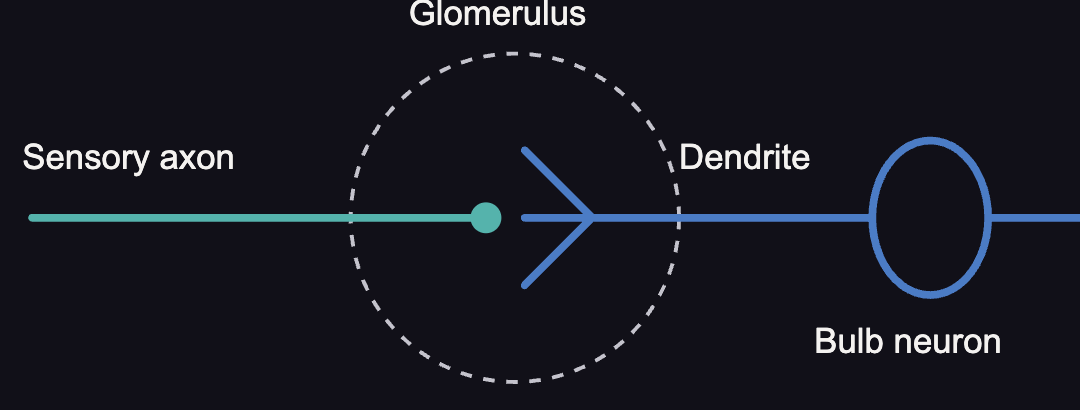
Follow the signal through four simplified stages: receive, relay, project and distribute. This model is designed to show the route of information flow, not anatomical scale or every neuron, synapse, feedback pathway or intermediate region.
When the system changes
Studying receptors, neural signals, brain regions and behavior separately allows us to measure each part of olfaction. It does not automatically tell us what will emerge when those parts interact. The more interesting question is how variations within a known system—differences in receptors, timing, connection strength, memory or sensory loss—can produce outcomes that were not predictable from any one component alone.
A familiar representation may also remain stable when some input is missing. Experiments in mice found that recurrent connections—connections through which cortical neurons influence one another—helped stabilize piriform odor representations after sensory input was degraded. That makes the question of partial smell more precise. The issue may not be only whether the signal becomes weaker, but whether the remaining information is enough for the network to recover a familiar pattern. Bolding et al., 2020
Stephen Wolfram’s work holds an interesting comparison about predictive behavior. His work on undecidability and computational intractability asks where the limits of prediction may begin. A system can follow clear rules while still resisting a simple shortcut to its outcome. In some cases, answering a question about that system may require carrying out the computation itself. Can we really say what the outcome of a person’s experience will be if we do not yet have the theoretical structure needed to follow the emergent process as it unfolds? Here, emergent means that the outcome develops through interactions across the system rather than sitting inside one isolated part. Wolfram, 1985
Hopfield networks give us one way to explore this question. A Hopfield network is a recurrent artificial neural network, so activity can feed back through the network rather than moving in only one direction. Patterns are stored through the strengths, or weights, of its connections. When the network receives a partial or noisy version of a stored pattern, those interactions can guide it toward a stable match. This is called content-addressable memory: recovering a whole pattern from part of it. Hopfield, 1982
Show the math
Pattern · Weights · Update · Attractor
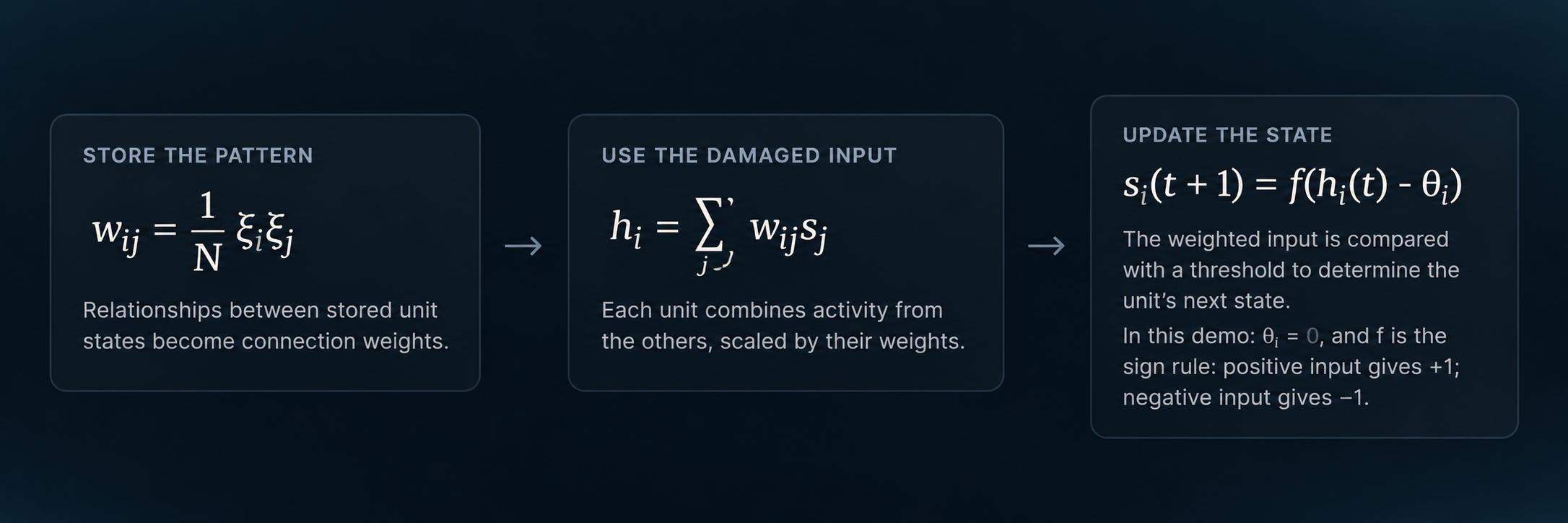
How can a network recover a pattern when some of the input is missing?
Suppose a neural system has a familiar activity pattern, but the incoming signal is now incomplete or degraded. The important question is not only how much the input changed. We can also ask whether the network’s resulting pattern ends up closer to the familiar one than the damaged input was.
We can represent that idea schematically as:
Δoutput < Δinput
Here, Δ means difference from the familiar pattern. Δinput describes how different the incoming signal is from that pattern. Δoutput describes how different the network’s resulting activity is from it.
How can the network use its connections?
A pattern is made from the activity of many units in a network. To understand how that pattern can change, we can first look at what influences one unit.
hi(t) = Σj wijsj(t)
Each incoming contribution is scaled by its connection strength, then the contributions are combined.
How does the network choose its next state?
si(t+1) = f(hi(t) − θi)
The weighted input is compared with a threshold to determine the unit’s next state. In this demo, θi = 0, and f is the sign rule: positive input gives +1 and negative input gives −1.
How can a pattern be stored in the weights?
wij = (1/N) ξiξj, i ≠ j
wii = 0
Information about the stored pattern has been written into the relationships between units. Units that share the same stored state contribute a positive weight; units with opposite stored states contribute a negative one.
From repeated updates to a stable pattern
Each unit receives weighted input from the current pattern, updates its state, and changes the inputs received by other units. In some recurrent networks, repeating this process can lead to a stable pattern called an attractor.
In simplified form: incomplete pattern → weighted interactions → repeated updates → stable pattern
What this model does not claim
This is not a simulation of piriform cortex. Real neural circuits include biological timing, inhibition, changing synaptic strengths, neuromodulation, sparse connectivity and many other processes that are not represented here. The Hopfield model isolates one idea: recurrent weighted interactions can allow a network to recover stable structure from incomplete input.
Current AI systems offer two more comparisons. Many large language models are trained by predicting the next token from the context that came before it. I-JEPA follows a different path with images: it uses visible regions of an image to predict representations of hidden regions rather than recreating every missing pixel. These systems work very differently from an olfactory circuit, but each gives us another way to ask what a network can derive from relationships within the information available to it. Brown et al., 2020, Assran et al., 2023
Systems thinking gives these comparisons a specific job: looking for recurring relationships without turning resemblance into a biological claim. Hopfield networks show one mathematical route to pattern recovery. I-JEPA shows a different kind of prediction from partial context. Language models show how learned weights can transform context into a structured output. The mechanisms are not the same. The shared question is more narrow: what can a system recover or infer from the relationships that remain? In olfaction, could two people encounter the same molecule but arrive at different experiences because their receptors, timing, memories and network dynamics guide the system toward different patterns?
What remains unsolved
This brings us back to smell loss with better questions. A person reporting little or no smell has told us something important about their experience, but that report does not show us where the interruption occurred or what activity remains. To understand how smell affects emotion, we need to follow detection, representation, awareness and bodily response separately, then investigate how they operate together. Less input may create a weaker experience, but it could also create a different interpretation of what remains.
That changes the question we started with. A smell is not simply a molecule carrying a fixed experience into the brain. It is a chemical event entering a biological system, where receptor differences, timing, recurrent circuitry, learning and prior experience can change what pattern becomes available to perception. The molecule matters, but so does the system receiving it. That helps explain how the same chemical can be overwhelming to one person, faint to another, or apparently absent altogether—and why losing part of the signal may change more than its intensity.
Show the source trail
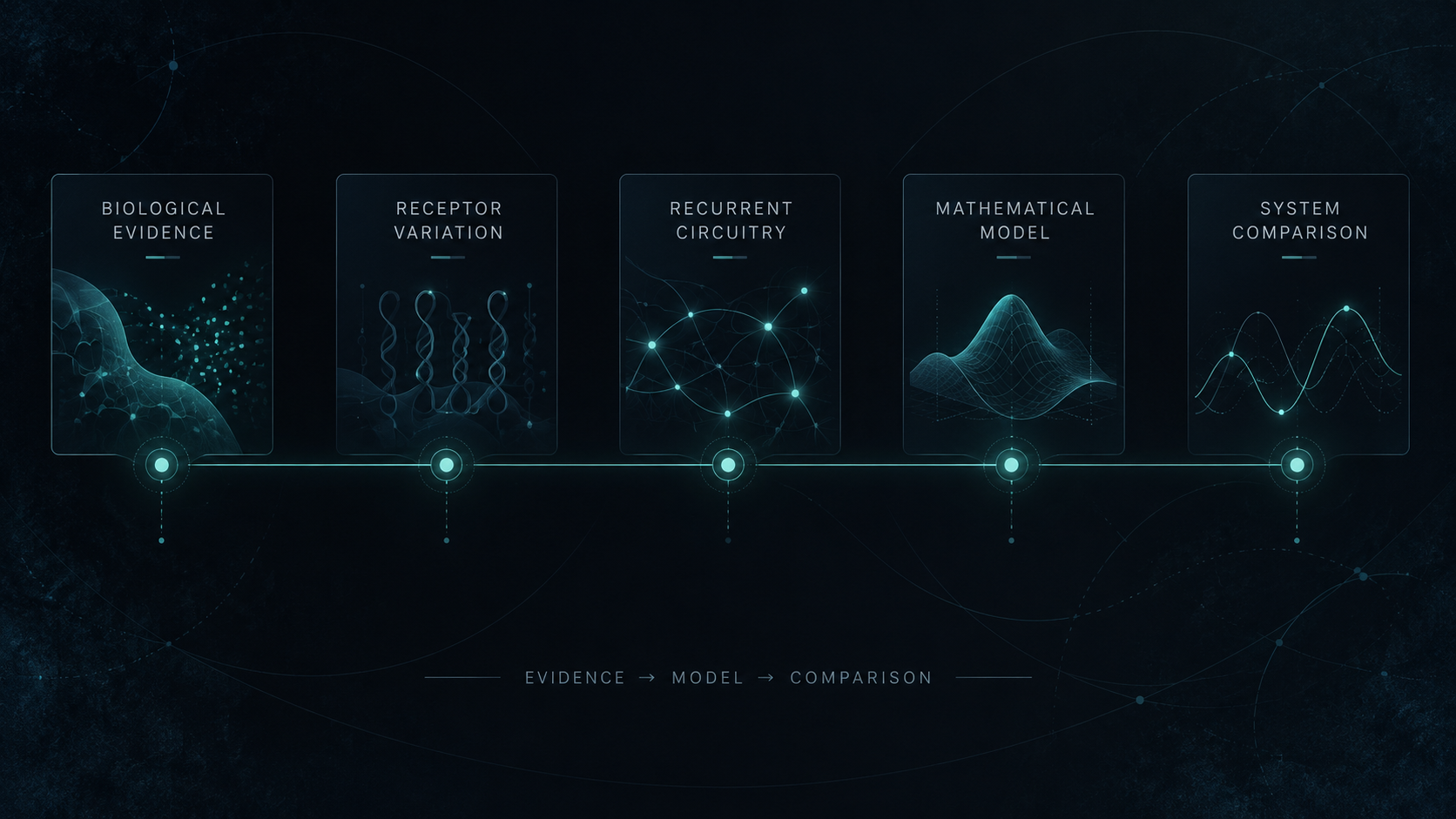
Evidence · Models · Comparisons
Olfactory connections with emotion-related regions
Used for anatomical evidence that parts of the amygdala receive direct projections from the olfactory bulb. This supports the article’s description of smell entering circuitry associated with emotion; it does not establish that smell directly causes a particular emotional state.
Smell and depressive symptoms
Used for the observed association between poorer odor identification and a greater risk of significant depressive symptoms over time in older adults. This is an association, not evidence that smell loss directly causes depression.
Why the same molecule can smell different
Used for the relationship between variation in the OR7D4 odor receptor and differences in how people perceive androstenone.
How odor patterns are represented
Used for work examining how the timing and structure of olfactory-bulb input can influence distributed responses in piriform cortex.
Pattern stabilization in piriform cortex
Used for evidence that recurrent circuitry in piriform cortex helps stabilize cortical odor representations when sensory input from the olfactory bulb is degraded.
Limits of prediction
Used as a comparison about prediction and computational limits: systems can follow definite rules while some questions about their behavior remain difficult or impossible to shortcut. This is not evidence that olfaction itself follows Wolfram’s models.
A mathematical model of stable pattern recovery
Used for the attractor-network model explored in the math layer. The Hopfield network is a simplified mathematical example of how recurrent weighted interactions can recover a stored pattern from incomplete input. It is not a model of piriform cortex itself.
Comparisons with artificial intelligence
Used for the comparison with language models trained through next-token prediction. This is a comparison between information systems, not a claim that language models operate like olfactory circuitry.
Used for the I-JEPA comparison: predicting representations of hidden image regions from visible context rather than reconstructing every missing pixel.
These sources do not all provide evidence for the same claim. Some support biological observations, some describe mathematical models, and some are used only as comparisons across systems.
Leave a Reply